Earned Automation: Why Our Idle Game Is Taking Automation Away (From New Players)
Mithril & Mud hands new players six automation systems in one free panel at minute ten. We're redesigning that into a progression track of named dwarves you earn — here's the research and the design pillars behind it.
Mithril & Mud is our dwarven mining incremental, in Early Access on Steam since March. This is its first appearance on the studio blog, and fittingly it’s about the biggest design change we’ve made since launch: a system we call Earned Automation, arriving in the game’s next update.
The short version: the game currently gives away its best rewards for free, all at once, in a settings panel. We’re fixing that.
The problem: six rewards disguised as one menu
M&M has a healthy stack of automation — auto-buy for workers, auto-assign across rooms, auto-convert resources, auto-collect and redeploy expeditions, auto-delve deeper. Today all of it lives in one automation panel that unlocks about ten minutes in, as a wall of toggles.
Before redesigning anything we did a research pass across the games that define this genre — Antimatter Dimensions, Trimps, NGU Idle, Leaf Blower Revolution, A Dark Room, Universal Paperclips, Factorio — plus the long-running community debates about gating quality-of-life features. The pattern in the best-loved incrementals is unmistakable: automation is the reward structure of the genre. Antimatter Dimensions hands out its autobuyers one at a time, each tied to a progression proof, and each one lands as a real moment. Trimps does the same. The relief of not having to do a thing anymore is the genre’s core dopamine — and M&M was spending six of those moments in a single free panel at minute ten.
The design pillars
The research distilled into a handful of rules we wrote down before touching code:
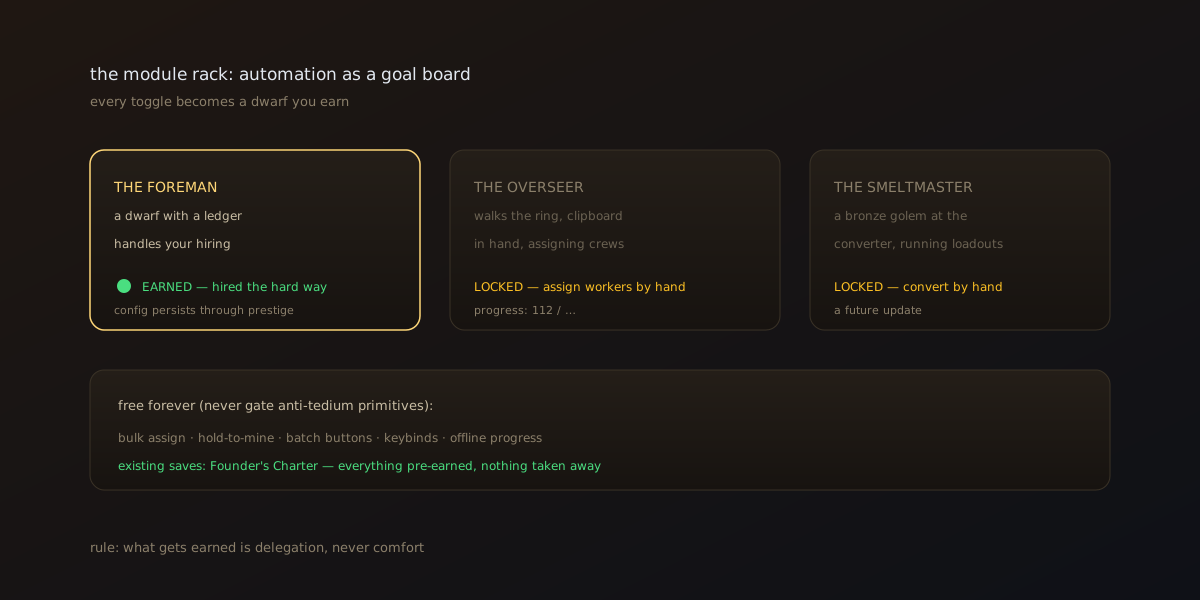
Visible before earnable. Locked content with an explicit unlock condition does half the motivational work. The automation panel becomes a goal board, not a settings menu — you can see what’s coming and what it will take.
The relief must land on a real pain — briefly. The ideal automation unlock arrives 30 to 60 minutes after the manual version becomes rote. Pain that lasts hours breeds genuine frustration; a cure with no pain is invisible. The unlock thresholds are being calibrated against the actual irritation curve of play, not round numbers.
Never gate anti-tedium primitives. This is the line the community draws, and they’re right to draw it: bulk assignment, hold-to-mine, batch buttons, keybinds, offline progress — if not having it hurts your wrist, it’s not content. All of that stays free forever. What gets earned is delegation, never comfort.
Narrative delegation is the cheapest magic. A Dark Room taught everyone this: “the builder stokes the fire” beats a checkbox every single time. So in M&M, automation isn’t toggles — it’s dwarves. The Foreman is a dwarf with a ledger who handles your hiring. The Overseer walks the room ring with a clipboard, reassigning workers. When you earn a module, a character appears in your cave and starts doing the job you’ve proven you’re tired of doing. The mine visibly staffs itself.
Earn by doing. The unlock conditions come from your own manual labor — hire enough workers by hand and the Foreman shows up to take over; assign enough workers yourself and the Overseer decides you’ve done your time. The qualification for delegating a job is having done that job. This also quietly redeems the early game: all that manual clicking in your first session now counts toward something.
Ownership is permanent — and “the Foreman remembers.” Modules persist through prestige and ascension, like any meta-progression. Better: owning a module means its configuration survives prestige. Today, every prestige wipes your automation settings and you rebuild them by hand; under the new system, your dwarves remember how you like the mine run. An annoyance becomes the reward for having earned the staff.
The three-act structure that was already there
What convinced us this was the right design is that the game’s own math already tells this story in three acts. Early on, active play dominates — your hands in the dirt, and by the code’s own numbers a held click outperforms a small crew of workers. In the mid-game, workers overtake clicking and the rote loops emerge — which is exactly when the modules start arriving, each one retiring one loop. In the late game, post-prestige, the mine largely runs itself, and your hands stay in the game through the deliberately-manual layer: cave-ins, raids, deep cavern choices, the timing of the prestige itself. Those stay manual by design. They’re the punctuation that makes idle feel earned.
We also decided against an auto-clicker, and expect to hold that line. The active-mining bonus is the early game’s identity; automating it would delete Act One instead of graduating from it.
The rule that mattered most: never take anything away
There’s one move these communities punish without mercy: removing quality-of-life that players already have. So the migration rule was non-negotiable from day one — every existing save keeps everything. Current players receive the “Founder’s Charter”: all modules pre-earned, with a celebratory popup, framing their head start as an honor rather than a bypass. Only brand-new saves walk the earning path. Existing players lose nothing and gain the config-persistence benefits; new players get a better game than the one we launched.
We’re shipping the system in stages rather than one mega-patch — the first phase introduces the module rack with the earliest dwarves, and the locked cards on the rack do the marketing for the rest. Each subsequent module is its own update with its own character.
The transferable lesson
If your game (or product) hands users a pile of conveniences on day one, it’s worth asking what you’re spending. Every convenience is a potential moment — a felt transition from “I do this” to “this is handled.” Given away in bulk, they’re a settings page. Sequenced against the user’s own demonstrated effort, they’re a progression system you already built and forgot to charge for — not in money, but in the currency that actually matters in a game: earned relief.
Mithril & Mud is in Early Access on Steam, with news and patch notes at mithrilandmud.com.